Cedar-apple rust identification & organic treatment
Gymnosporangium juniperi-virginianae
How to identify cedar-apple rust
A fungus with a bizarre two-host life cycle, spending part of its life on juniper/red-cedar trees (forming orange gelatinous 'horns' in spring) and part on apple and crabapple leaves and fruit.
Symptoms
- Bright yellow-orange spots on apple leaf upper surfaces in late spring/early summer
- Spots enlarge and develop tiny black dots (spermogonia) in the center
- Orange, tube-like tufts form on the underside of the leaf spot later in the season
- Fruit can show yellow-orange spotting and mild distortion in heavy years
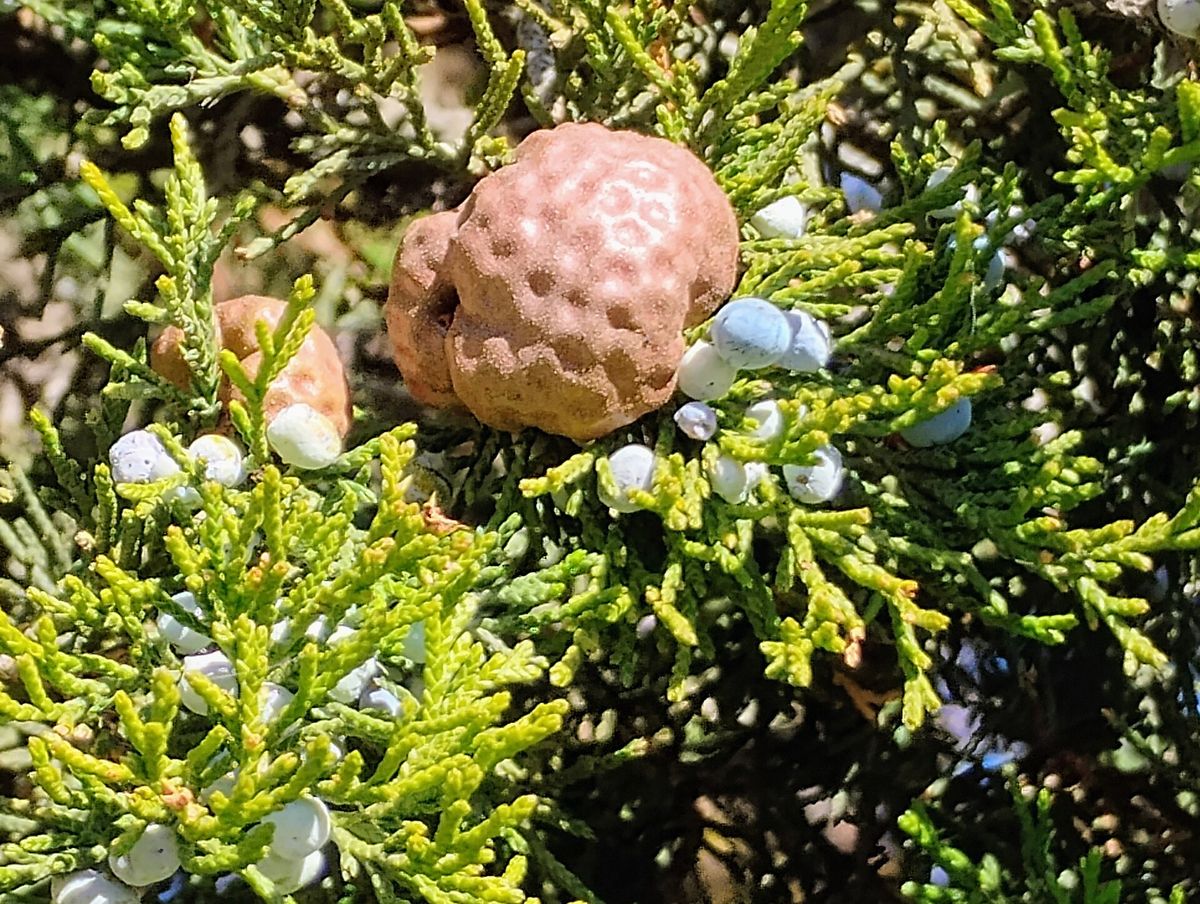
- On nearby juniper/red-cedar, telltale orange gelatinous 'horns' erupt from brown galls after spring rain
Host crops
Apple.
How it spreads
Spores travel from infected juniper galls to apple trees on the wind in spring rain, then in mid/late summer travel back from apple leaves to nearby junipers; needs both hosts within a couple miles to complete its cycle.
Favorable conditions
Wet, mild spring weather (50-75°F) during the several-day window when juniper galls are actively releasing orange spore horns.
Progression
- Juniper gall swells (Late winter/early spring) — Brown woody galls on juniper absorb water and swell.
- Orange horns erupt (Spring rain events) — Gelatinous orange tendrils release spores toward apple trees.
- Apple leaf infection (Following weeks) — Yellow-orange leaf spots develop.
- Return spores to juniper (Mid-late summer) — Apple leaf spots produce spores that re-infect juniper, completing the cycle.
Organic treatment for cedar-apple rust
- 1. Remove nearby juniper galls · medium effort
In late winter, prune and destroy the brown woody galls on any juniper/red-cedar within a few hundred feet, before they swell in spring rain.
When: Late winter, before spring rains
- 2. Copper or sulfur fungicide on apple · medium effort
Apply an OMRI-listed copper or sulfur spray at pink bud through petal fall on the apple tree to block spore infection.
When: Spring, bud break through petal fall
- 3. Rake and remove fallen leaves · low effort
Clean up infected apple leaves in fall to reduce local pressure, though most inoculum still comes from junipers.
When: Fall cleanup
Prevention
- Plant rust-resistant apple varieties if junipers are nearby and can't be removed.
- Keep at least a few hundred yards between apple trees and ornamental junipers/red-cedar where feasible.
- Time preventive copper/sulfur sprays to the local juniper 'horn' event each spring.
Easy to confuse with
Apple scab (olive-green velvety spots, not orange), Nutrient deficiency chlorosis.