
How to grow celeriac
Family Apiaceae. Hardy to USDA hardiness zone 4a+ (U.S. Department of Agriculture). Full sun to part shade. Ready in 100-120 days.
Sun
Full sun to part shade
Spacing
8-10 in
Days to harvest
100-120 days
Hardiness
Zone 4a+
What growers actually recorded
Loading zone 7b results…
When to plant celeriac
- Start indoors: ~10 weeks before last frost.
- Transplant out: ~2 weeks after last frost.
Companion plants for celeriac
Plant with: Leek, Bean, Tomato.
Avoid near: Carrot, Parsnip.
Common pests & problems
Celery leaf tier, slug.
Feeding & fertilizer
N-P-K ratio: Low N, higher P (3-6-6)
Organic options: Compost only in bed prep · Bone meal at sowing · Skip nitrogen top-dress
When to feed: Feed the bed, not the plant. Carrots/parsnips fork or hair-root with fresh manure.
Watch for: Forked roots = too much N or fresh manure; use only well-aged compost.
N = nitrogen (leaves), P = phosphorus (roots and flowers), K = potassium (fruit and disease resistance). How to read a fertilizer label →
Grower's tip
Needs a long, steady season: start indoors early and keep soil evenly moist the entire time or the knob stays small.
When to plant celeriac in your zone
Free month-by-month sowing and transplanting lists, built from frost dates for your USDA (United States Department of Agriculture) hardiness zone.
Soil & water for celeriac
Soil & pH
6.0-6.8
Deep, fertile, moisture-retentive loam, similar to celery's needs but slightly more tolerant of average garden conditions once established.
Work in 3 in of compost; celeriac benefits from the same steady fertility program as celery but is more forgiving of brief moisture lapses.
Watering
1.5 in / week, kept consistent
Drip or soaker hose. Less demanding of constant sogginess than stalk celery but still stressed badly by drought.
Check soil 3 in down; if dry, water. A knobby, hollow-centered root at harvest usually traces back to a dry spell mid-season.
Knowing when to harvest
- Root (hypocotyl bulb) reaches 3-5 in diameter, usually 100-120 days after transplanting.
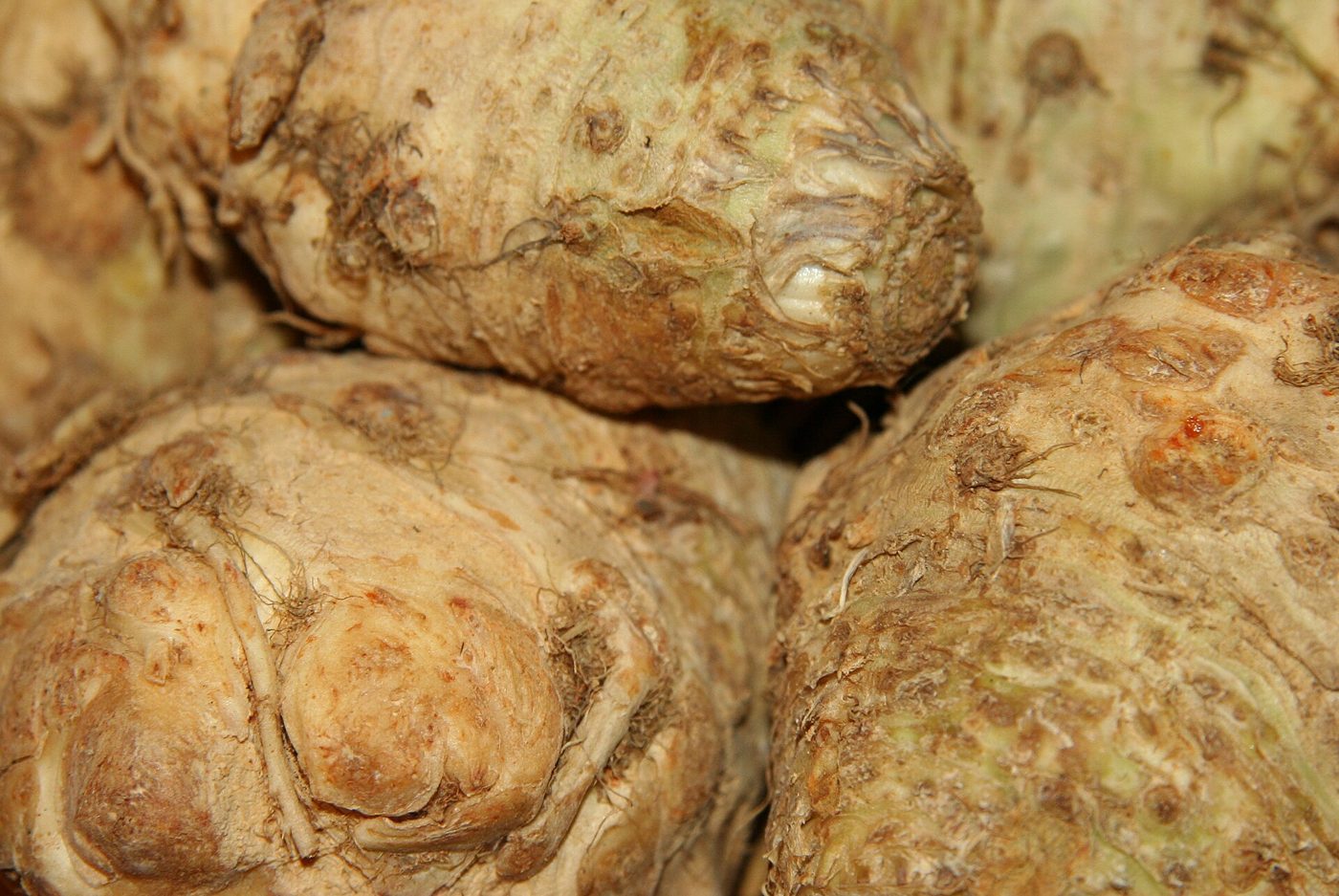
- Outer skin turns rough and tan-brown; interior stays creamy white.
- Improves in flavor after light frost but, unlike parsnip, should be dug before the ground freezes hard.
Storing & keeping
Trim foliage to 1 in, store unwashed at 32-38°F, 90-95% humidity, packed in damp sand or a perforated bag, for 4-6 months.
What to expect
Per plant: 1 root, 0.75-1.5 lb
Per sq ft: 1 plant per sq ft
Troubleshooting celeriac
Small, golf-ball-sized roots
Likely cause: Inconsistent watering or too-short a season for a slow, 100+ day crop
What to do: Start seed indoors 10-12 weeks before last frost and keep watering steady all season.
Hollow, brown center when cut open
Likely cause: Boron deficiency or drought stress, same root cause as celery's stalk pitting
What to do: Maintain even soil moisture and apply boron per soil test if the bed has a known deficiency.
Rough, knobby exterior with many side roots
Likely cause: Uneven watering through the growing season
What to do: Mulch to buffer moisture swings; water on a fixed schedule rather than reactively.
Varieties worth growing
Brilliant
Smooth-skinned with less peeling waste than older types.
Prague Giant
Large, reliable roots; the standard home-garden variety.
Mars
Good disease resistance and stores well into winter.
Growing celeriac in containers
15-gallon or larger deep container works reasonably well since the bulb, not a long taproot, is the harvested part; keep watering consistent.
Nutrition
Beta-carotene, vitamin K, luteolin (parsley). A nutrient bargain per square foot.
Common questions
Is celeriac the same plant as celery?
Same species, different cultivar group, bred for a swollen root rather than long stalks. The flavor is celery-like but earthier.
How do I clean up the root for cooking?
Trim the knobby crown and side roots away with a knife rather than a peeler; the surface is too irregular for standard vegetable peelers.
Where these numbers come from
- USDA Plant Hardiness Zone Map (2023 revision). Zone assignment and the 30-year normals behind every cold-hardiness figure.
- NOAA NCEI 1991-2020 Climate Normals. Frost dates, growing-season length, and the probability bands on both.
- Cornell, UMN, and UC Davis Cooperative Extension crop guides. Spacing, days to maturity, soil pH targets, and per-plant yield ranges.
- USDA FSIS / FDA Produce Safety guidance. Wash, cure, and cold-storage handling numbers.
Ranges are regional guidance, not a promise for your yard. Your own logged results always override the published range.