
How to grow kohlrabi
Family Brassicaceae. Hardy to USDA hardiness zone 3a+ (U.S. Department of Agriculture). Full sun to part shade. Ready in 45-60 days.
Sun
Full sun to part shade
Spacing
6-8 in
Days to harvest
45-60 days
Hardiness
Zone 3a+
What growers actually recorded
Loading zone 7b results…
When to plant kohlrabi
- Start indoors: ~6 weeks before last frost.
- Transplant out: ~-3 weeks after last frost.
- Direct sow: ~-3 weeks after last frost.
Companion plants for kohlrabi
Plant with: Onion, Beet, Cucumber, Dill.
Avoid near: Tomato, Pole bean.
Common pests & problems
Cabbage worm, flea beetle, aphid.
Feeding & fertilizer
N-P-K ratio: High N (10-5-5): heavy feeders
Organic options: Aged manure or compost worked in deep · Blood meal or feather meal side-dress at 3 wks · Fish emulsion every 2 wks
When to feed: Feed heavily every 2-3 weeks. Brassicas want steady nitrogen for tight heads.
Watch for: Pale/yellow leaves = needs N. Loose heads = feed harder next round.
N = nitrogen (leaves), P = phosphorus (roots and flowers), K = potassium (fruit and disease resistance). How to read a fertilizer label →
Grower's tip
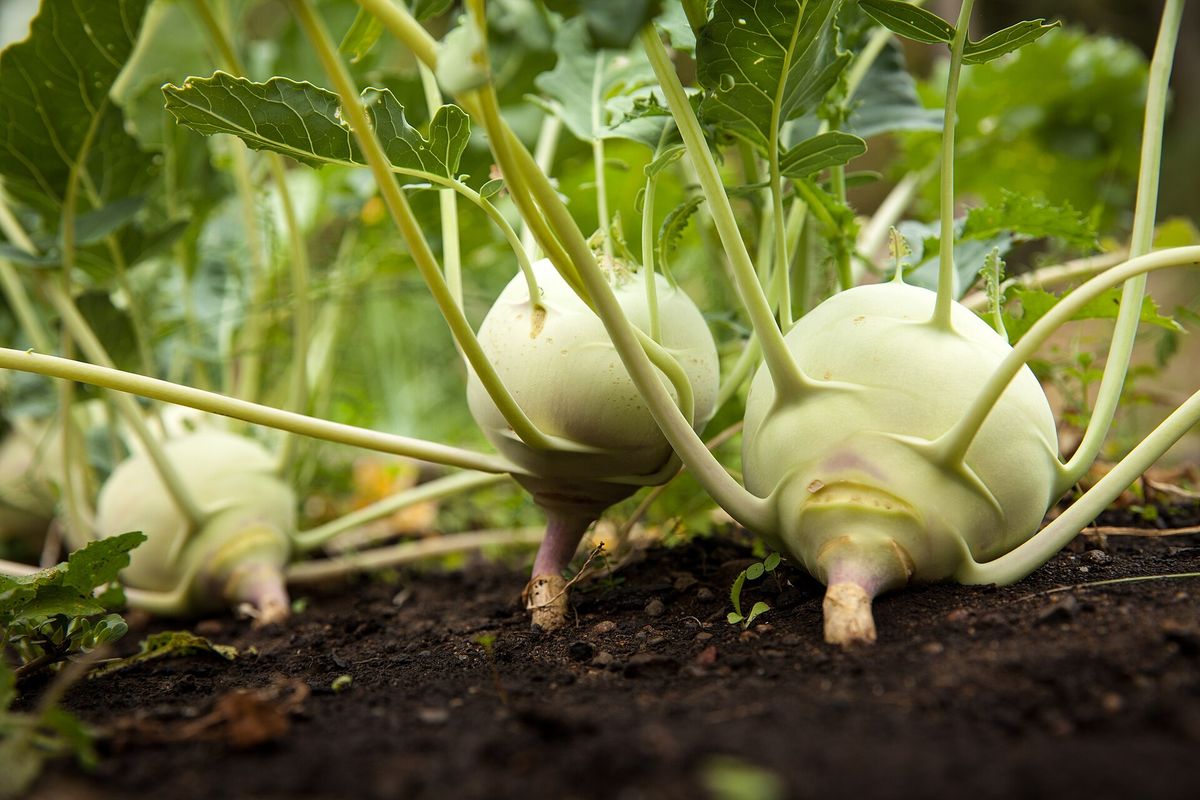
Harvest the swollen stem at tennis-ball size, no bigger: past that it turns woody and fibrous fast.
When to plant kohlrabi in your zone
Free month-by-month sowing and transplanting lists, built from frost dates for your USDA (United States Department of Agriculture) hardiness zone.
Soil & water for kohlrabi
Soil & pH
6.5-7.5: near neutral (raises club-root resistance)
Fertile loam with strong drainage. Firm soil beats fluffy for heading brassicas.
Compost 2 in + 1 cup of alfalfa or feather meal per 10 sq ft. Lime if pH is under 6.5. It also blocks club-root.
Watering
1-1.5 in / week, consistent
Ground-level drip. Uneven water during heading = split heads or bolting.
Lift an edge of the row and check soil at 3 inches. If it clings in a damp ball, hold off. If it crumbles, water until the top 6 inches are evenly moist.
Knowing when to harvest
- Bulb reaches 2-3 in across (tennis-ball size); larger bulbs on standard varieties turn woody and fibrous.
- Skin should be smooth and taut, not cracking.
- Leaves stay upright and glossy; drooping older leaves are fine to trim as the bulb sizes up.
Storing & keeping
Trim leaves, refrigerate bulb at 32-40°F, 90-95% humidity for 1-2 months. Peel the tough outer layer before eating raw or cooked.
What to expect
Per plant: 1 bulb, 0.5-1 lb
Per sq ft: 4-6 bulbs per sq ft
Troubleshooting kohlrabi
Bulb splits
Likely cause: Irregular watering, especially a dry spell followed by heavy rain
What to do: Keep soil evenly moist throughout bulb formation; mulch to buffer swings.
Tough, woody texture
Likely cause: Harvested too large or grown through heat
What to do: Pick at 2-3 in and grow as a spring or fall crop; giant varieties like Superschmelz are the exception, bred to stay tender larger.
Varieties worth growing
Early White Vienna
Fast, classic pale-green bulb for small gardens.
Purple Vienna
Purple skin with white flesh, slightly more cold-hardy.
Superschmelz
Giant type that stays tender even at 8-10 in across.
Growing kohlrabi in containers
8-10 in deep pot works well; kohlrabi's compact root system suits containers better than most brassicas.
Nutrition
Sulforaphane, glucosinolates, vitamin K, calcium. Brassicas are the vegetable powerhouse.
Common questions
Do I eat the bulb or the leaves?
Both. The swollen stem (bulb) is the main crop, peeled and eaten raw or cooked, but the leaves are edible too and cook much like collards.
Why is my kohlrabi called a 'German turnip' but not related to turnip?
It looks similar above ground, but kohlrabi's bulb is a swollen stem, not a root, and it belongs to the same Brassica oleracea species as cabbage and broccoli.
Where these numbers come from
- USDA Plant Hardiness Zone Map (2023 revision). Zone assignment and the 30-year normals behind every cold-hardiness figure.
- NOAA NCEI 1991-2020 Climate Normals. Frost dates, growing-season length, and the probability bands on both.
- Cornell, UMN, and UC Davis Cooperative Extension crop guides. Spacing, days to maturity, soil pH targets, and per-plant yield ranges.
- USDA FSIS / FDA Produce Safety guidance. Wash, cure, and cold-storage handling numbers.
Ranges are regional guidance, not a promise for your yard. Your own logged results always override the published range.