
Peachtree borer identification & organic control
Synanthedon exitiosa
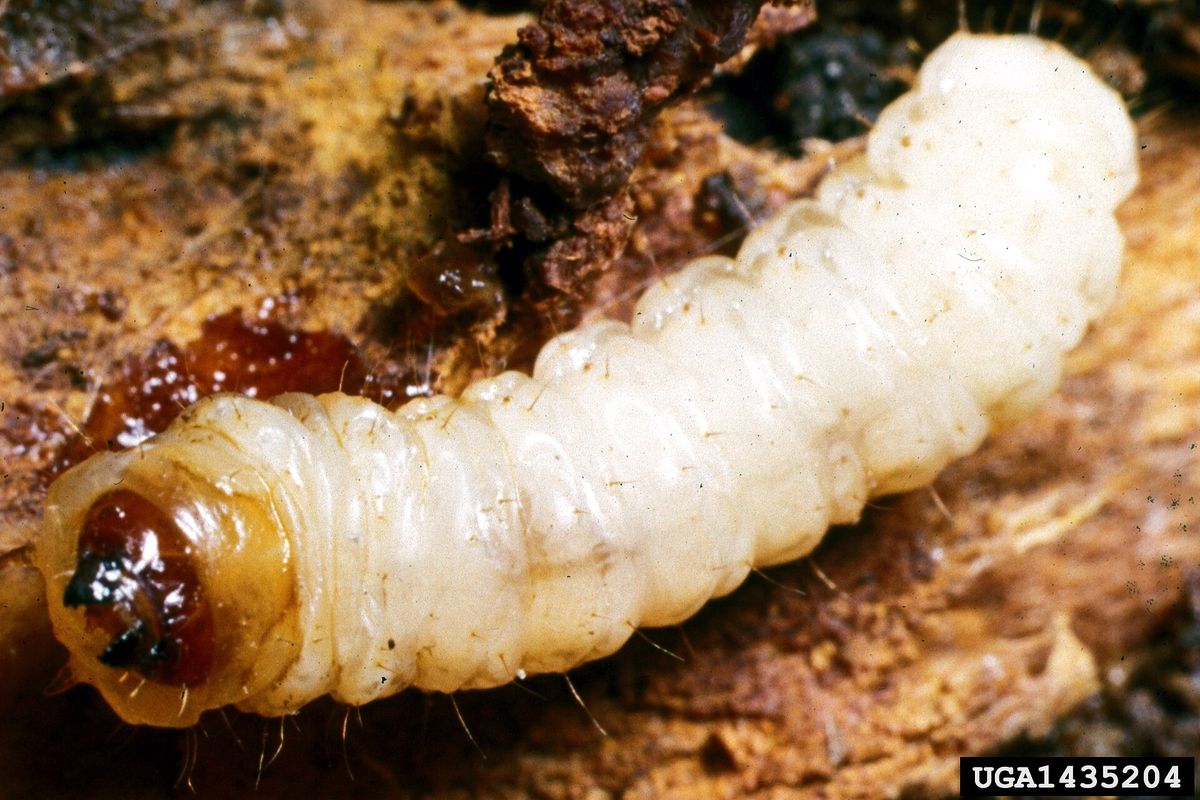
How to identify peachtree borer
A clear-winged, wasp-mimicking moth whose larvae tunnel into the trunk at or just below the soil line, girdling the tree over time. Gummy sap mixed with frass at the base of the trunk is the telltale sign.
Crops attacked by peachtree borer
Peach, Plum, Cherry.
Larvae feed in the cambium layer at the trunk base, cutting off the flow of nutrients; repeated attacks over several years can kill young trees.
Life cycle
- Overwintering larva (Winter (in trunk)) — Feeding continues in mild spells.
- Larva resumes feeding (Spring) — Trunk tunneling near the soil line.
- Pupa (Early summer) — In a cocoon at the base of the trunk.
- Adult moth (Summer) — Lays eggs on bark near the trunk base.
Natural, organic peachtree borer control
- 1. Check trunk base for gummy frass · low effort
Inspect the lower 12 inches of trunk each spring and fall; gummy, sawdust-flecked ooze means larvae are present.
When: Spring and fall
- 2. Remove larvae with a wire · medium effort
Probe visible entry holes with a stiff wire to kill the larva inside without cutting into healthy wood.
When: When frass is found
- 3. Keep mulch and mower damage away from the trunk · low effort
Wounds from mowers or piled mulch attract egg-laying females; keep a bare, mulch-free ring right at the trunk.
When: All season
Fastest-fix products
- Stiff wire probe — Simple mechanical removal of larvae inside the trunk. · Any hardware store
- Beneficial nematodes applied at trunk base — Can help control larvae in the soil around the crown. · Arbico Organics
Prevention
- Avoid trunk wounds from mowers, string trimmers, and heavy mulch piled against bark.
- Paint young trunks with white latex paint diluted with water to deter egg-laying and reduce sunscald.