
Spider mite identification & organic control
Tetranychus urticae
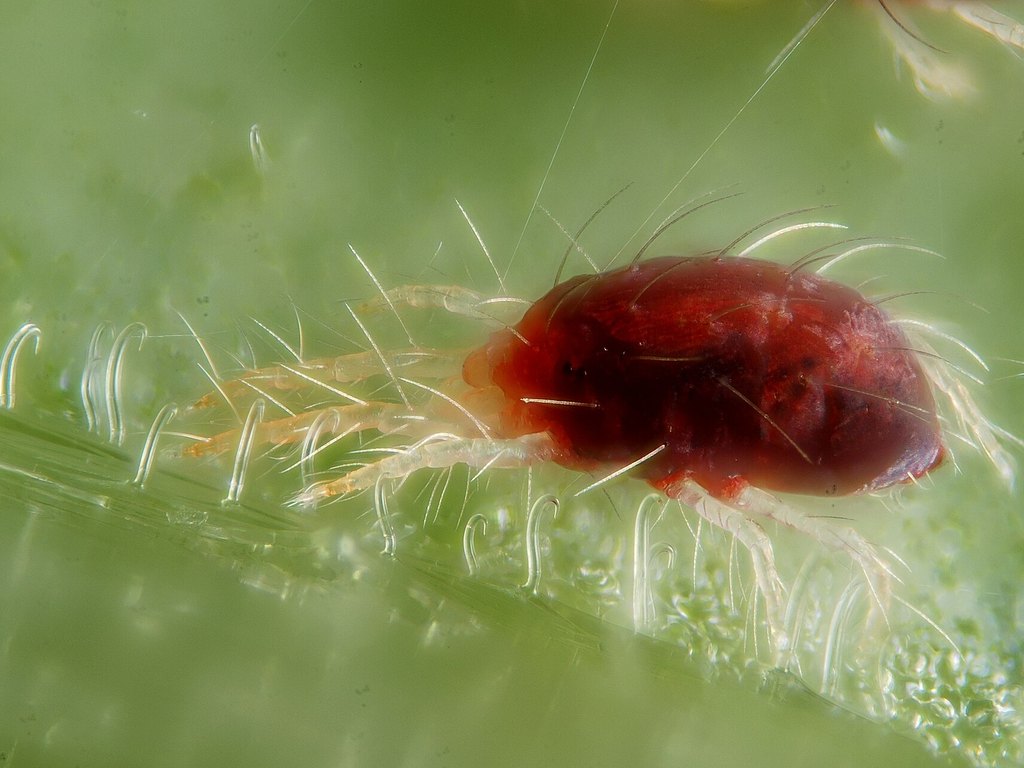
How to identify spider mite
Spider mites are not true insects. They are eight-legged arachnids, barely visible without a hand lens. A single colony looks like pale dust on a leaf underside; by the time you see fine silk webbing between stems and leaves, the population is already booming. They love heat, drought, and still air, and in hot weather a generation can complete in 5 days.
Crops attacked by spider mite
Bean, Tomato, Strawberry, Cucumber, Melon, Squash, Basil, Eggplant, Pepper.
Mites pierce individual leaf cells and suck out the contents, leaving a constellation of tiny yellow-white flecks. Leaves eventually bronze, curl, and drop. Heavy infestations wrap leaves and stems in webbing. The plant loses vigor, yields smaller fruit, and in severe cases dies back.
Life cycle
- Egg (2-3 days at 80°F) — Minute, translucent spheres laid along leaf veins on the underside.
- Larva (6 legs) (1-3 days) — First active feeding stage; pale green and barely mobile.
- Nymph (8 legs) (2-4 days) — Two nymphal stages; the main feeding and damage window.
- Adult (1-3 weeks) — Tiny yellow-green or red mite; females lay 100+ eggs each, often on a single leaf.
- Overwintering female (Late fall through winter) — Turns orange-red and shelters in bark, leaf litter, and garden debris, waiting for warmth.
Natural, organic spider mite control
- 1. Blast leaf undersides with water · low effort
A sharp, directed jet of water on the underside of leaves dislodges mites, washes away dust, and raises local humidity. Repeat every 2-3 days for a week, then weekly.
When: First sign of stippling
- 2. Raise humidity around the crop · low effort
Mist plants in the morning and again on hot evenings, or place water trays nearby. Spider mites thrive in dry air; even a small humidity boost slows their reproduction.
When: Hot, dry weather
- 3. Release predatory mites (Phytoseiulus persimilis) · medium effort
These specialist predators eat spider mites and nothing else. Release them directly onto infested leaves in the evening. They clear outbreaks in 1-2 weeks and reproduce as long as spider mites are present.
When: Established infestation
- 4. Horticultural oil or insecticidal soap at dusk · medium effort
Thoroughly coat leaf undersides. Oil smothers eggs and adults; soap dries out soft-bodied mites. Repeat every 5 days for 3 cycles to catch each hatch. Avoid bees by spraying at dusk.
When: Heavy infestation
- 5. Clear and compost cautiously · low effort
Remove heavily webbed leaves and stems and bag them or hot-compost them. Do not leave infested debris sitting in the bed: it becomes a nursery.
When: When webbing is concentrated
Fastest-fix products
- Phytoseiulus persimilis predatory mites — Live biological control that hunts spider mites while leaving pollinators and other predators alone. The best solution for tunnels and high-value crops. · Arbico Organics, Nature's Good Guys
- Insecticidal soap or neem oil — Fast contact control that kills mites and eggs without leaving harmful residues. Best used on a 5-day cycle. · Garden centers, Amazon
- Hand lens or 10x loupe — Early detection is the difference between a quick water blast and a month-long war. Look for moving specks on leaf undersides. · Amazon, science supply stores
Prevention
- Keep paths and beds from getting dusty. Dust favors mites and kills their predators.
- Ease off high-nitrogen fertilizer; succulent new growth is a magnet for mites.
- Mist or lightly irrigate during heat waves to keep humidity above the leaf surface.
- Inspect bean, tomato, and strawberry leaves weekly from mid-summer onward; mites are easiest to stop early.
- In the fall, clear garden debris and prune dense vegetation to reduce overwintering shelter.