
Thrips identification & organic control
Frankliniella / Thrips spp.
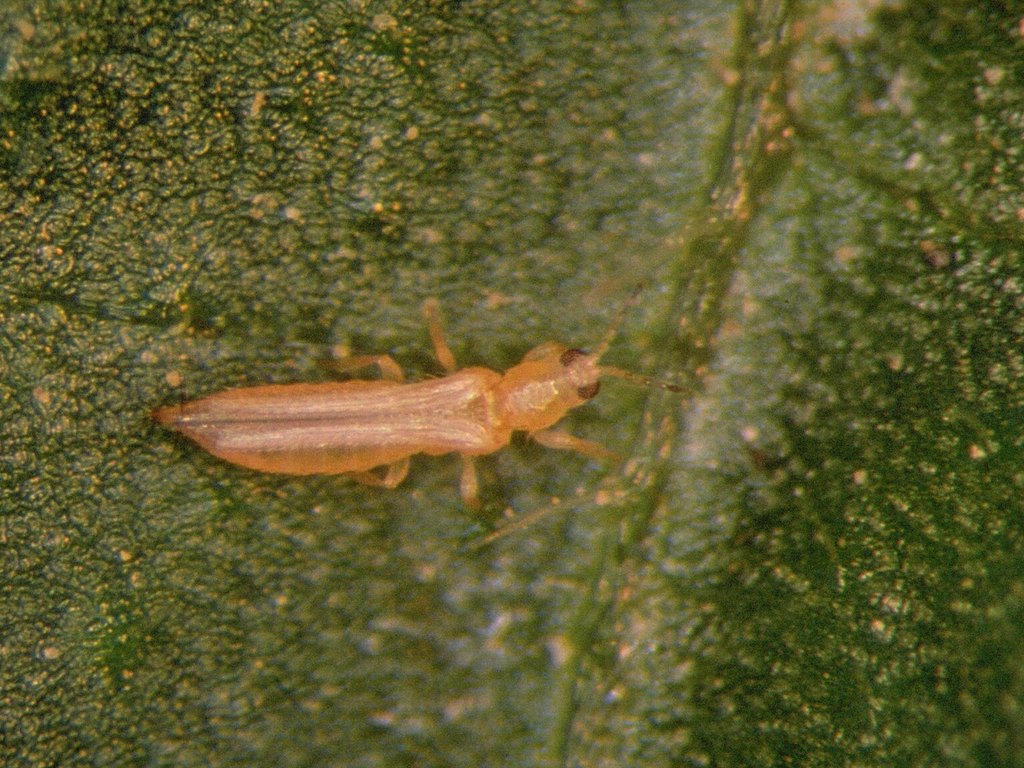
How to identify thrips
Slender insects barely 1/25 in long, pale yellow to dark brown, that rasp plant cells open and drink the contents. They also vector tomato spotted wilt and impatiens necrotic spot virus, which is often worse than the feeding itself.
Crops attacked by thrips
Onion, Tomato, Pepper, Bean, Cucumber, Lettuce, Flowers.
Rasping-sucking damage leaves silvery-white stippling and streaks, black varnish-like frass dots, distorted new growth, and scarred fruit. Flowers brown and drop.
Life cycle
- Overwintering adults (Winter) — In plant debris, weeds, and greenhouses.
- Eggs in leaf tissue (Spring) — Inserted into leaves and stems: invisible from outside.
- Larvae (2 instars) (Spring → summer) — Main feeding stage; silvering and virus transmission.
- Pupae in soil / new adults (All warm season) — Generation every 2-3 weeks in heat: populations explode fast.
Natural, organic thrips control
- 1. Blue or yellow sticky cards · low effort
Hang cards at canopy height to monitor and knock down adult numbers. Blue catches thrips best.
When: From transplant on
- 2. Overhead rinse and remove weeds · low effort
A hard water rinse dislodges larvae; clearing grassy weeds removes their spring reservoir.
When: Weekly in dry spells
- 3. Release predatory mites · medium effort
Amblyseius cucumeris or swirskii sachets clipped into the canopy hunt thrips larvae continuously.
When: At first detection
- 4. Spinosad or insecticidal soap · medium effort
Spinosad works well but must be sprayed at dusk to spare bees; rotate products to avoid resistance.
When: Heavy pressure
Fastest-fix products
- Blue sticky traps — Both a monitor and a control; thrips are strongly drawn to blue. · Amazon, greenhouse suppliers
- Amblyseius cucumeris sachets — Slow-release predatory mites. The most reliable long-term suppression. · Arbico Organics, Koppert
- Spinosad concentrate (Monterey) — OMRI-listed and one of the few organics that truly dents thrips. · Garden centers
Prevention
- Reflective silver mulch strongly reduces thrips landings and virus spread.
- Remove weedy borders and old onion/allium debris.
- Inspect nursery transplants before bringing them home: thrips arrive as hitchhikers.